
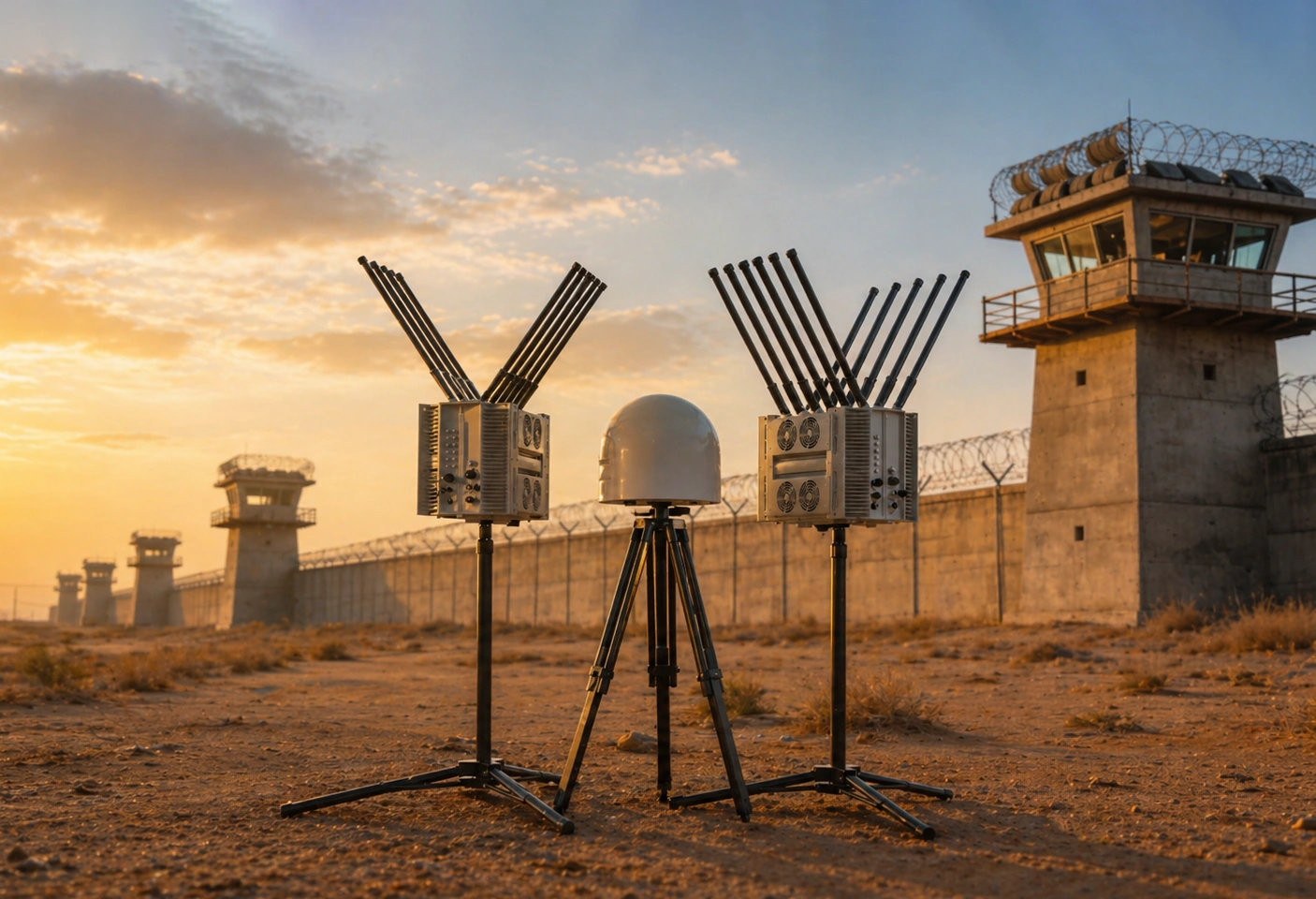
Prison Anti-Drone Solution
A counter-UAV solution for prison perimeter protection, helping detect, track and respond to unauthorized drones carrying contraband or conducting surveillance.
Quick Summary
- Best for: Correctional facilities, prison perimeters, yards, watchtowers, rooftops and restricted areas.
- Core configuration: Perimeter RF detection, radar or EO/IR confirmation, command room alarms and portable or fixed response equipment.
- Deployment type: Fixed perimeter monitoring supported by patrol teams and portable countermeasure devices.
- Quote inputs: Perimeter length, blind spots, watchtower locations, nearby public areas and allowed response policy.
Why prisons need anti-drone protection
Unauthorized drones can be used for contraband delivery, surveillance or disruption around correctional facilities. A layered counter-UAV system helps security teams detect threats early and coordinate response before drones reach sensitive zones.
Recommended system architecture
Typical prison deployments combine RF drone detection, perimeter radar, EO/IR tracking cameras, command management software and fixed or portable countermeasure equipment where permitted.
Deployment areas
Common protected areas include outer perimeter fences, watchtowers, yards, rooftops, entrance checkpoints, storage areas and nearby approach paths.
Project workflow
Confirm the protected perimeter, map blind spots, choose fixed or mobile equipment, integrate alarms into the command room and test coverage after installation.
Get a Custom Anti-Drone Solution Quote
Tell us your protected area, deployment scenario, expected coverage and local compliance requirements. Our team can recommend a suitable counter-UAV configuration for your project.
FAQ
How can prisons stop drones from delivering contraband?
Prison projects should focus on early detection around the perimeter and fast operator response. RF detection can identify suspicious drone activity, radar or EO/IR equipment can help confirm the target, and portable or fixed countermeasure equipment can be prepared according to legal permissions. The system should also connect with the prison command room so alarms, patrol teams and response records are handled consistently.
Which anti-drone equipment is suitable for prison perimeter security?
For prison perimeter protection, fixed detection systems such as P4 can monitor key zones, radar can cover open or complex areas, H8 and D7 can support portable on-site response, and K100 can be considered for fixed countermeasure coverage where Ku-band threats are relevant. The best choice depends on perimeter length, blind spots, nearby public areas and allowed response methods.
Can a prison anti-drone system work at night?
Yes. RF detection and radar are not dependent on daylight, and EO/IR equipment can support visual confirmation in low-light or night conditions. For night operation, the design should consider watchtower visibility, lighting conditions, operator duty workflow and whether alarm information needs to be pushed to mobile patrol teams.
What should be checked before designing a prison anti-drone solution?
Before design, it is useful to confirm the perimeter length, building layout, yard locations, watchtower positions, likely drone approach directions, surrounding residential or road areas, allowed countermeasure policy, command room integration requirements and whether the prison needs fixed, portable or mixed deployment.